Separating business and personal expenses in Canada gives you cleaner records, more reliable tax filing, and a clear view of your company’s actual performance. The practical starting point is creating a visible boundary between business revenue, personal money, and costs that serve both purposes.
Using dedicated accounts, documenting every transaction, and claiming only the true business portion of mixed-use costs helps build records you can readily explain to the CRA. Tools like Rubiwo help Canadian freelancers and small businesses organize receipts and maintain compliant expense tracking year-round, turning bookkeeping from a frantic year-end chore into a simple routine.
Key Takeaways
- Use dedicated banking and payment methods exclusively for business activity.
- Categorize business-only, personal, and mixed-use expenses with proper supporting records.
- Record owner payments and shared costs using a consistent, defensible method.
Set Up a Clear Divide Between Business and Personal Money
Opening a dedicated business bank account is the foundation of clean bookkeeping. Use it exclusively for business income, revenue, and spending, while keeping your personal account strictly for household and lifestyle costs. Add a dedicated business credit card if your day-to-day operations require a separate payment method.
Canadian financial institutions—such as RBC, TD, and CIBC—offer accounts tailored to various business structures. Your choice should match your transaction volume, fee tolerances, payment needs, and access to business credit.
- Sole Proprietorships: While incorporation isn’t legally required to open a business account, separate accounts make expense tracking infinitely easier.
- Partnerships: Clear accounts are essential for tracking shared partner contributions and withdrawals accurately.
- Corporations: Because an incorporated business is a separate legal entity, keeping corporate and personal finances completely distinct is mandatory.
Your Basic Workflow:
- Deposit all business income straight into your dedicated business account.
- Pay business invoices and expenses directly from that account or business credit card.
- Transfer money to yourself using a formal method (such as an owner’s draw, salary, dividend, or documented reimbursement).
- Keep personal lifestyle purchases entirely out of your business records.
Note: Repeatedly paying for personal groceries or family expenses through a business account creates messy cleanup and distorts your true business profitability.
What Counts as a Business Expense Under CRA Rules?
The Canada Revenue Agency (CRA) permits deductions for reasonable costs incurred to earn business income, provided they are supported by appropriate source documents. The business purpose, amount, and documentation must logically align with your income-generating activities.
Eligible vs. Personal Expenses
- Common Deductions: Office supplies, tools, software subscriptions, advertising, professional fees, utilities, and business travel. Meals and entertainment are also eligible, provided you record the date, location, amount, business purpose, and attendees.
- Personal Lifestyle Costs: Personal grocery runs, family vacations, or household utility bills do not magically become business expenses just because money moved through a business account. Keep them out unless a legitimate, defensible business-use allocation applies.
Under the Income Tax Act, you must support every claim with receipts, invoices, or agreements. Good records protect your tax savings and keep you compliant; unsupported claims risk denied deductions, audits, and financial penalties.
Handle Mixed-Use Costs and Owner Payments Correctly
Mixed-use expenses require you to calculate and claim only the true business-use percentage using a reasonable, consistent method. Always document the total cost, your allocation math, and the underlying evidence.
- Home Office Deductions: Use a consistent area- or time-based calculation. You may claim a business portion of rent, utilities, mortgage interest, and home insurance where rules permit. Remember: Home office claims cannot create or increase a business loss.
- Vehicle Expenses: Maintain a detailed mileage log showing business kilometers, total kilometers, dates, destinations, and trip purposes. Apply your business-use percentage to eligible fuel, insurance, repairs, and financing costs.
- Assets & Tech: Phone plans, internet bills, and hardware used for both personal and business purposes require similar proportional tracking.
Categorizing Owner Payments
- Owner’s Draw: Transfers money from a sole proprietorship to you; this is not a business expense.
- Salary: Requires formal payroll records and proper source deductions.
- Dividends: Corporate distributions carrying specific documentation and tax treatments.
- Reimbursement: Repays a documented business cost that you paid out-of-pocket personally.
- Shareholder Loans: Tracks money advanced to or taken from a corporation; these require careful management. (Incorporated business owners should consult an accountant regarding shareholder loans and personal assets).
Build a CRA-Ready Expense Tracking Routine
Recording each expense immediately, attaching the receipt, and noting the business purpose while details are fresh prevents missing records and year-end panic.
- Essential Data Fields: Capture the date, supplier, amount, tax charged, payment method, category, and business purpose.
- Format Choice: Spreadsheets work for very low transaction volumes, but cloud software or mobile apps like Rubiwo streamline receipt capture, tax field mappings, and input tax credit (ITC) tracking for GST/HST registrants.
- T2125 Alignment: Structure your categories to transfer cleanly onto Form T2125 at tax time. Reconcile your accounts monthly to catch categorization errors early.
Use Rubiwo to Keep Expenses Organized Year-Round
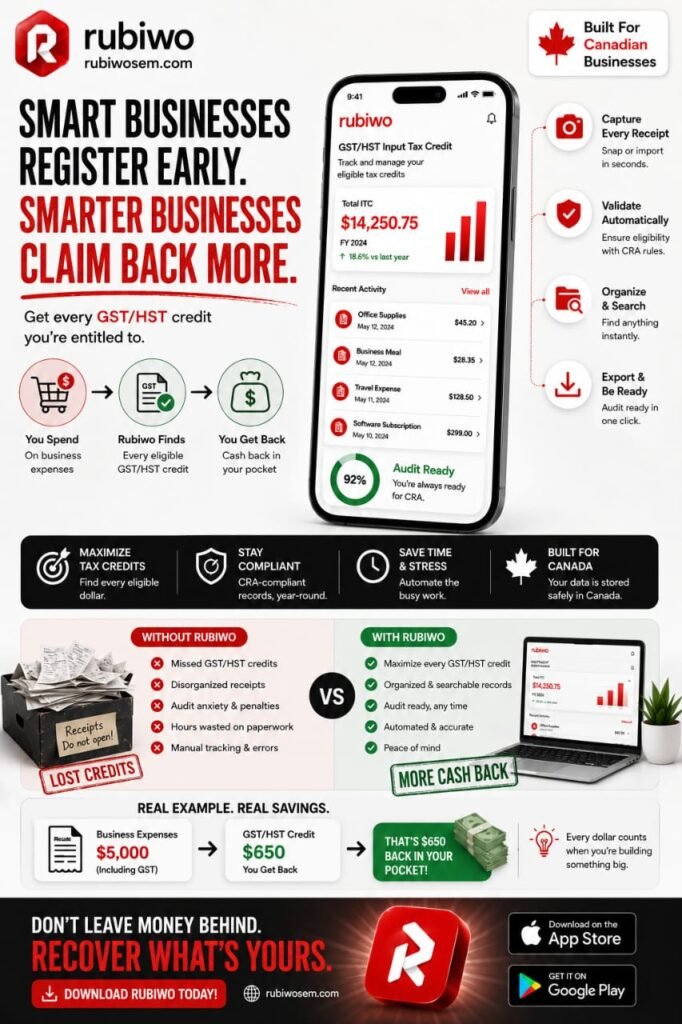
Rubiwo is a CRA-compliant expense tracking app built specifically for Canadian freelancers and small businesses, available on iOS and Android at rubiwosem.com.
Unlike generic tools built for US tax systems or manual spreadsheets prone to data entry fatigue, Rubiwo keeps Canadian receipt management, GST/HST tracking, and category rules connected to every purchase. It simplifies your bookkeeping workflow so you can walk into tax season with confidence. (Note: You ultimately decide how expenses are categorized; for uncertain deductions, always consult a qualified accountant).
Frequently Asked Questions
- Should a sole proprietor have a business bank account? Yes. While not strictly mandated by law for sole proprietors, a dedicated business account vastly simplifies bookkeeping, tax filing, and CRA compliance.
- Can I pay a business expense with my personal bank account? Yes. You can pay personally and log it as an owner contribution or an amount owing to you. Just ensure you keep the receipt, note the business purpose, and keep the reimbursement paper trail clear.
- Do I need a business credit card? A business card helps isolate business purchases and establish a clean audit trail. However, using it for a purchase doesn’t automatically make that purchase tax-deductible—it still must serve a valid business purpose.
- How should I record mixed-use expenses? Track the total cost, calculate a defensible business-use percentage, and claim only that portion. Always keep supporting proof like a mileage log, floor-plan calculation, or time-use record.
- Can I claim a home office deduction? Yes, if your workspace meets CRA criteria and your calculation is supported by documentation. Keep in mind that home office expenses cannot create or increase a business loss.
- How do I track vehicle expenses? Maintain a rigorous mileage log tracking business kilometers, total kilometers, dates, and destinations. Apply your business percentage to eligible operating costs and keep your fuel and maintenance receipts.
- What should I do if the CRA questions an expense? Provide your receipt, payment proof, business purpose notes, and allocation math. If an expense involves complex corporate structures, payroll, or uncertainty, lean on your accountant for support.
For a practical way to organize receipts and expense records throughout the year, try Rubiwo, the CRA-compliant expense tracking app for Canadian freelancers and small businesses, available on iOS and Android at rubiwosem.com.