A receipt is CRA compliant when it clearly shows the date, seller name, amount, and a description of what you bought. You can check compliance by confirming your receipt has all required details, matches the correct type for your expense, and stays legible for the full retention period. Missing or unclear information is one of the most common reasons expense claims get flagged during a CRA compliance review.
Many business owners assume any receipt will do, but the CRA has specific rules about what counts as valid proof of an expense — including the seller’s business number for larger purchases and separate documentation for GST/HST claims.
This guide breaks down what makes a receipt valid, how to spot problems early, and what to do if your records fall short.
Key Takeaways
- A valid receipt needs specific details like the date, seller information, and a clear description of the purchase.
- Different expense types and GST/HST claims often require extra documentation beyond a basic receipt.
- Keeping organized, legible records year-round makes tax filing and audits much easier to handle.
CRA Record-Keeping Standards
The CRA sets clear rules for what receipts must show, how long you need to keep them, and what formats count as valid proof.
Purpose of Supporting Documents
Supporting documents prove that the amounts on your tax return are accurate. The CRA uses receipts, invoices, and other records to verify your reported income and expenses.
Without proper documents, the CRA can deny your expense claims — meaning you could owe more tax, plus interest and penalties.
Every receipt should support a specific business transaction: a purchase, a sale, payroll, or any other activity that affects your taxes. Organized records make it easier to answer CRA questions if they contact you.
Required Retention Periods
The CRA requires you to keep most business records for six years from the end of the last tax year they relate to. Records from your 2024 tax year, for example, must be kept until the end of 2030.
Some records need longer retention:
- Permanent records, like incorporation documents, should be kept indefinitely
- Property records should be kept until you sell the property, plus six more years
- Payroll records may need extra retention if disputes arise
If you want to destroy records early, you must apply for CRA permission first.
Acceptable Paper and Digital Records
The CRA accepts both paper and digital receipts, as long as the information is clear and complete. Digital copies must be legible and unaltered.
If you scan paper receipts, use a resolution that keeps the vendor name, date, amount, and tax information readable.
Cloud storage is allowed, but back up your files in case of technical issues. The CRA doesn’t require a specific software system — your records just need to be easy to access on request.
Essential Receipt Details
A CRA-compliant receipt needs specific information to prove your purchase. Missing even one detail can weaken your records during an audit.
Vendor Identification
Your receipt must clearly show who you bought from — the business name, address, and often a GST/HST registration number if the vendor charges sales tax. This confirms the transaction happened with a legitimate business.
Without it, the CRA may question whether the expense is real or connected to your business.
Check that the vendor’s name on the receipt matches the name on your bank or credit card statement to avoid confusion during bookkeeping.
Transaction Date
Every receipt needs a clear date. This confirms the expense falls within the correct tax year and helps you match the receipt to your bank or credit card records when reconciling your books.
A smudged, faded, or missing date makes a receipt harder to defend during a review. Digital receipts usually include a timestamp, which works just as well as a printed date.
Goods or Services Description
Your receipt should explain what you actually bought. A vague description like “supplies” or “services” isn’t enough — the CRA wants specifics, like “printer paper” or “website design consultation,” so the connection to your business is clear.
This description also helps you sort expenses into the right categories at filing time, and protects you if the CRA questions a deduction. If a receipt only shows a total with no breakdown, ask the vendor for an itemized version.
Amounts, Taxes, and Payment Evidence
The receipt must show the total amount paid, along with any GST or HST charged separately. You can only claim input tax credits on the tax portion — not the full amount — so an unclear breakdown weakens an ITC claim.
You also need proof of how you paid: cash, debit, or credit card.
| Detail | Why It Matters |
|---|---|
| Subtotal | Shows cost before tax |
| GST/HST amount | Supports input tax credit claims |
| Total paid | Confirms final transaction amount |
| Payment method | Verifies how the expense was settled |
Keeping these four elements together on one receipt gives you a complete, defensible record.
Receipt Types and Documentation Rules
Different receipt types follow different rules. Some work well on their own; others need extra documents to back them up.
Point-of-Sale Receipts
A point-of-sale receipt needs the vendor’s name, the date, a description of what you bought, and the total amount paid.
If the purchase was $100 or more before tax, it also needs the GST/HST number, usually printed near the bottom.
Faded thermal paper is a common problem — scan or photograph these receipts soon after purchase so the text stays readable for the full retention period.
Invoices and Supplier Statements
Invoices from suppliers and contractors need more detail than a basic sales receipt: the seller’s business name, an invoice number, the date of service or delivery, and a breakdown of items or services with prices.
You also need the total amount, taxes charged separately, and the GST/HST registration number if applicable — important for claiming input tax credits.
Supplier statements summarizing multiple purchases are useful but don’t replace individual invoices. Keep both, since the CRA may ask for the original invoice during a review.
Online Purchase Confirmations
An email confirmation is valid as long as it includes the seller’s name, order date, itemized costs, and total amount charged.
Screenshots work too — make sure the full page is visible, not a partial view. Save these files in a folder by year or expense category.
If the confirmation email is missing the GST/HST number, check your account order history or contact the seller directly.
Credit Card and Bank Statements
Statements show that a payment happened, but not what was purchased — they’re not enough on their own to prove a business expense.
Pair every statement entry with the matching receipt or invoice. Highlight or note business expenses on your statement, then attach the matching receipt image or file, so everything is easy to match if the CRA asks.
GST/HST Input Tax Credit Requirements
Claiming input tax credits requires receipts that meet specific CRA standards, depending on the purchase amount, whether the supplier’s GST/HST number is included, and how clearly the tax amount is shown.
Information Thresholds by Purchase Amount
The CRA uses a tiered system — your receipt needs more detail as the dollar amount goes up.
- Under $100: basic proof of payment (supplier’s name and date)
- $100 to $499.99: supplier’s name, date, total amount paid, and the GST/HST amount (or a note that it’s included)
- $500 or more: everything above, plus the buyer’s name, a description of the goods or services, and the terms of payment
Registrant Number Verification
Every receipt used to claim an ITC must include the supplier’s GST/HST registration number for purchases of C$100 or more. This proves the seller is registered to collect and remit tax. Without it, your claim can be denied even if everything else on the receipt checks out.
You can verify a number using the CRA’s GST/HST registry search tool. If a supplier can’t provide a valid number, don’t use that receipt to support an ITC claim.
Tax Amount Disclosure
Your receipt must clearly show how much GST or HST you paid, or state that the total already includes it — and this amount needs to match what you claim on your GST/HST return.
A lump sum without a tax breakdown may not support your claim. A credit card statement alone doesn’t meet this standard either, since it won’t show the tax breakdown the CRA requires. Always keep the original invoice or receipt, not just a summary of the charge.
Expense-Specific Evidence
Different expense types need different proof — a basic receipt often isn’t enough on its own.
Meal and Entertainment Expenses
A restaurant receipt alone doesn’t satisfy CRA requirements. Record who you met with, their business relationship to you, and the purpose of the meeting — write it on the back of the receipt or in a notebook right after the meal, since memory fades fast.
Meal and entertainment costs are only 50% deductible in most cases. Your receipt should still show the full amount paid, the date, vendor name, and an itemized list.
Vehicle and Travel Costs
Vehicle expenses need a logbook, not just gas and repair receipts. Track the date, destination, purpose, and kilometers driven for each business trip, plus your total kilometers for the year (business and personal), to calculate your business-use percentage.
For travel expenses like flights or hotels, keep receipts showing:
- Dates of travel
- Destination
- Business purpose
- Amount paid in the currency charged
Without a logbook, the CRA may deny vehicle expense claims even with valid receipts.
Home Office Purchases
Claiming home office expenses requires showing the percentage of your home used for business — usually based on the square footage of your workspace versus your entire home.
Keep receipts for rent, utilities, or mortgage interest, along with proof of your home’s total size (a floor plan or measurement note works). Separate business-use costs from personal ones: if you use one room out of five as an office, roughly 20% of your utility bills would typically qualify.
Capital Asset Acquisitions
Capital assets like computers, furniture, or equipment need more than a purchase receipt — the invoice must show the date of purchase, vendor name and address, buyer name and address, and a full description of the item.
For purchases over C$500, the invoice should be made out to your business, not to you personally.
You’ll also need to track the asset’s cost for depreciation (capital cost allowance). Keep the original invoice long-term, since you’ll use it to calculate deductions over several years.
Reviewing Legibility and Authenticity
A receipt must be readable and genuine to count as proof. Check that the text is clear and the document hasn’t been altered or improperly duplicated.
Missing or Faded Information
Thermal paper receipts fade over time, sometimes within a year or two. Check that the date, vendor name, amount, and GST/HST number are all clearly visible. If any are faded, scan or photograph the receipt right away — a receipt that becomes unreadable partway through the six-year retention window may not hold up in an audit.
If you can’t make out the details, ask the vendor for a duplicate copy.
Altered or Duplicate Documents
Watch for signs a receipt has been edited or copied: mismatched fonts, uneven spacing, or numbers that look pasted on. Filing the same receipt twice, or using a copy without a matching original, can also raise questions during a review.
Red flags to check for:
- Inconsistent formatting on totals or dates
- Missing security features like store logos or barcodes
- Handwritten changes on a printed receipt
- Multiple copies of the same transaction
If you use electronic imaging software to store receipts, make sure the scanned file matches the original exactly, and avoid edits after scanning.
Foreign Currency Transactions
Receipts from purchases made outside Canada need to be converted to Canadian dollars using the exchange rate from the day of the transaction. Keep the original receipt showing the foreign currency amount, and note the exchange rate you used and its source (such as the Bank of Canada’s daily rate).
Foreign receipts should still show the same core details as domestic ones. If a receipt is in a language other than English or French, keep a simple translation of the key details.
Correcting Incomplete Documentation
Missing details on a receipt don’t always mean you lose the deduction — you can often fix the problem.
Requesting a Replacement Receipt
Go back to the seller and ask for a corrected or duplicate receipt. Many businesses can reprint or email a copy if you ask soon after purchase — give them the date, amount, and payment method to help them find the record.
If you paid by card, ask for an itemized receipt instead of just a card slip, since a slip alone often doesn’t show what you bought.
Creating a Contemporaneous Expense Record
If you can’t get a replacement, write down the purchase details as soon as possible — close to the time of purchase, not months later. Include:
- The date of the purchase
- The amount paid
- The name of the vendor
- A short description of what you bought
- The business reason for the expense
Keep this record with any other proof you have, like a bank statement or email confirmation. The CRA looks more favorably on records made right away.
When Alternative Evidence May Be Used
You can sometimes support an expense without a traditional receipt — the CRA also accepts invoices, credit card statements, written contracts, and email or PDF confirmations.
Bank and credit card statements confirm the date and amount but usually not what you bought, so pair them with another document when possible. A combination of records — a calendar entry, an email confirming the purchase, and a bank statement showing the charge — can help reconstruct a missing receipt. Treat this as a backup option, not a routine replacement for proper documentation.
Organizing Records for Tax Filing and Audit Readiness
Good record keeping means more than saving receipts — you need a system that connects each receipt to your books, stores files safely, and prepares you for a possible CRA review.
Matching Receipts to Accounting Entries
Every receipt should link to a specific entry in your books, with the date, amount, vendor, and category matching exactly. If the numbers don’t line up, the CRA may question the expense — reconcile receipts against your bank and credit card statements monthly.
Enter receipts into your accounting system within a few days of purchase, and use consistent categories (office supplies, travel, meals) to speed up filing and catch errors early.
Digital Storage Practices
Store receipts digitally to protect them from fading, loss, or damage — the CRA accepts scanned or photographed receipts as long as they’re clear and complete.
Key practices:
- Use cloud storage or accounting software with receipt capture features, such as QuickBooks or Xero
- Name files clearly, using the date, vendor, and amount
- Back up your files in at least two locations
- Keep records for six years, as required by the CRA
Avoid storing receipts only on your phone — devices can be lost, damaged, or stolen.
Audit Preparation Checklist
The CRA can request records going back several years, so a clear system saves you time and stress. Use this checklist:
- Confirm all receipts match your accounting entries
- Store digital copies in an organized folder structure by year and month
- Keep bank and credit card statements alongside matching receipts
- Save copies of contracts, invoices, and payroll records
- Review your records twice a year to catch missing documents early
Frequently Asked Questions
What information must be included on a receipt to meet CRA requirements?
A valid receipt needs the date, vendor name, a description of the item or service, and the amount paid. If GST or HST was charged, the receipt needs to show that amount separately or state it’s included, along with proof of payment.
Does a CRA-compliant receipt need the seller’s GST/HST registration number?
Yes, for claiming an input tax credit — the registration number must appear on receipts for purchases over C$100. It’s good practice to check even on smaller purchases.
How can I verify whether a receipt is valid for claiming business expenses?
Check that it has the date, vendor name, amount, and a clear description, and compare it to your bank or credit card statement to confirm the payment. Make sure it’s legible and unaltered. If it’s faded, incomplete, or missing key details, ask the vendor for a corrected copy.
What details are required on a receipt for GST/HST input tax credits?
The GST/HST amount charged, the vendor’s business number, the date, a description of what was bought, and the total amount paid. For purchases over C$500, you also need your name or business name.
Are digital receipts accepted by the CRA for tax records?
Yes — including smartphone photos, as long as the image is clear and unaltered. All required details (date, vendor name, description, amount, tax information) must be fully legible.
How long should I keep receipts and supporting documents for CRA purposes?
Six years from the end of the tax year they relate to, whether you keep paper copies, digital files, or both.
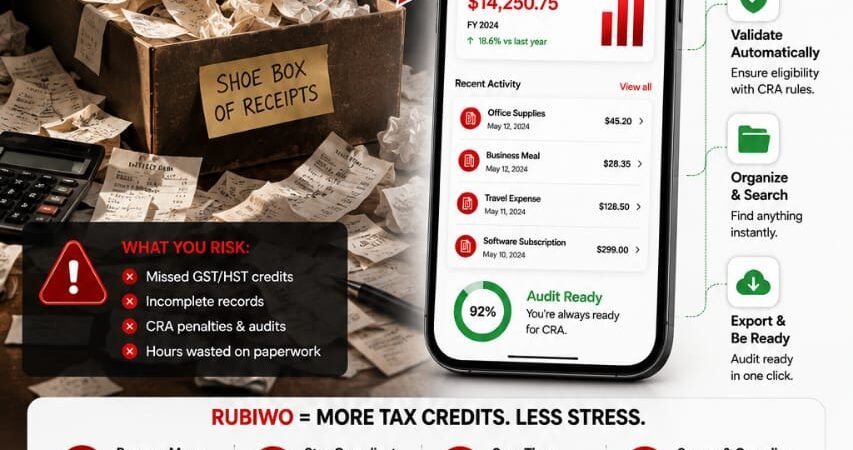
How RubiWo Automatically Validates Receipt Compliance
Checking every receipt by hand takes time. RubiWo removes that step by scanning and reviewing your receipts as soon as you upload them, comparing the details against what the CRA actually requires.
The app checks for the essentials at tax time:
- GST/HST numbers on the receipt and validate it for purchase over C$100
- Buyer name requirements for purchases over C$500
- PST details for cross-provincial transactions
- Date and vendor information
This compliance check happens in real time. If something is missing or doesn’t match CRA rules, you get a flag right away instead of finding out during an audit — and small gaps like a faded receipt or a missing tax number are easy to catch while the purchase is still fresh in your mind.
As a CRA-compliant expense app, RubiWo keeps your records organized and stored securely, with data staying within Canada.
Over time, this builds toward audit-ready reports — organized records ready to go, instead of digging through old receipts or trying to remember details months later.