Canadian freelancers, contractors, and sole proprietors often miss legitimate business expenses because purchases are scattered across email, bank statements, and paper receipts. The result is a tax return that reports business income accurately while leaving some eligible deductions unclaimed.
You can reduce your net self-employment income by claiming reasonable expenses that have a clear business purpose, the correct business-use allocation, and supporting records. RubiWo helps you organize those records in a Canadian-focused workflow, so you can approach tax time with clearer evidence for your T2125 and tax return.
A deduction reduces taxable income; it doesn’t create a dollar-for-dollar refund. Your actual tax reduction depends on factors like your marginal tax rate, the type of expense, and any CRA limits that apply.
Key Takeaways
- Track every reasonable expense that supports your freelance income.
- Allocate mixed personal and business costs using a defensible business-use percentage.
- Preserve receipts, business purposes, and supporting records throughout the year.
How Business Expenses Reduce Your Taxable Income
Eligible business expenses reduce your net self-employment income, which flows into your taxable income on your tax return. You report freelance activity and related expenses through Form T2125, Statement of Business or Professional Activities.
A deductible expense needs a direct business purpose, a reasonable amount, and adequate documentation. If an item serves both personal and business purposes, claim only the business-use portion. Personal expenses remain personal, even when paid from a business bank account.
$1,000 of eligible expenses, for example, reduces business income by $1,000 — but your tax savings depend on your marginal tax rate, so the deduction doesn’t equal a $1,000 refund. Self-employed Canadians also need to consider CPP contributions and whether GST/HST registration applies.
GST/HST registrants may claim input tax credits for eligible GST/HST paid on business purchases when the documentation supports the claim. Keep income records and expense records together, and separate GST/HST treatment from income-tax deductions when preparing your T2125.
Often-Missed Home Office, Technology, and Equipment Claims
Home office expenses, technology, and equipment are common deduction areas, with eligibility determined by business use, timing, and whether the cost is current or capital.
For a qualifying workspace, you may claim the business-use portion of eligible costs like rent, mortgage interest, property taxes, home insurance, utilities, and home internet. Your calculation should reflect a reasonable allocation based on workspace and, where relevant, time used for business. Keep invoices and document the method you used.
Office expenses can include supplies, stationery, and smaller items consumed in your work. Office furniture, computers, laptops, monitors, tablets, and cameras may be capital property — instead of deducting the entire purchase immediately, you may need to claim depreciation through capital cost allowance (CCA). The applicable class and first-year rules require care.
Software subscriptions are easy to overlook because payments recur monthly. Review cloud storage, project management tools, accounting software like QuickBooks, FreshBooks, or Wave, Google Workspace, domain registration, SSL certificates, and other website costs. Record the service, payment date, business purpose, and business-use percentage when personal use is mixed in.
Vehicle, Travel, and Meal Expenses That Need Extra Care
Vehicle expenses, business travel, and meals require a clear business purpose and records that separate work activity from personal use.
For a vehicle used partly for freelance work, calculate the business-use portion of fuel, insurance, repairs, maintenance, licence costs, interest, and eligible lease payments. A mileage log should record the date, destination, reason for the trip, and business kilometres. Keep odometer readings so your percentage is supportable.
Vehicle purchases are capital costs, so depreciation through CCA may apply. Claiming every kilometre driven or every vehicle bill without an allocation creates a weak file.
Business travel can include eligible flights, hotels, and local transportation when the trip supports your income-earning activity. Keep itineraries, invoices, and notes identifying the client, project, or business purpose.
Meals and entertainment have special limits. Record who attended, the business purpose, date, location, and amount, then apply the applicable CRA restriction. A receipt without context doesn’t establish why the meal was a business expense.
Professional Development, Marketing, and Overlooked Operating Costs
Professional development and operating costs qualify when they support your current business and are reasonable, documented expenses.
Courses, online courses, workshops, certifications, professional certifications, industry conferences, conference tickets, business books, and professional association memberships should connect to the skills or services that generate your income. Keep registration confirmations and a note explaining the business relevance — training for a new, unrelated field may receive different tax treatment.
Marketing costs often disappear into digital platforms. Review business cards, promotional items, Google Ads, Facebook Ads, email marketing, website promotion, and related creative services. Save invoices that identify the supplier, date, amount, and service.
Small financial charges accumulate over a year. Check your business bank account, bank charges, bank fees, credit card statements, and payment-processing costs from Square or Stripe. Reconcile these records so fees aren’t hidden inside deposits.
Professional fees may include legal fees, tax preparation fees, tax software, and accounting services connected to the business. Business insurance premiums can also be relevant. Bad debts require specific conditions and records, so document the customer, invoice, collection efforts, and reason the amount became uncollectible before claiming anything.
How RubiWo Makes Tax-Ready Expense Tracking Easier
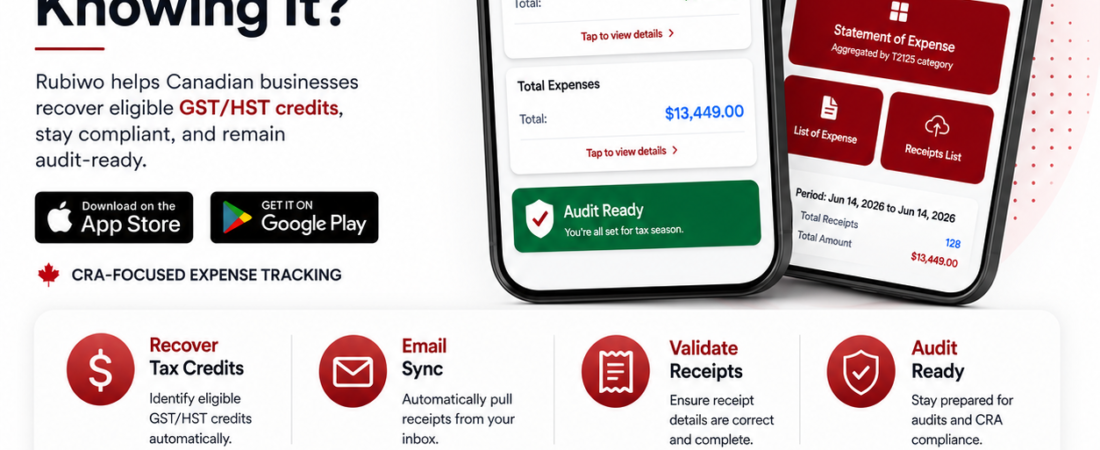
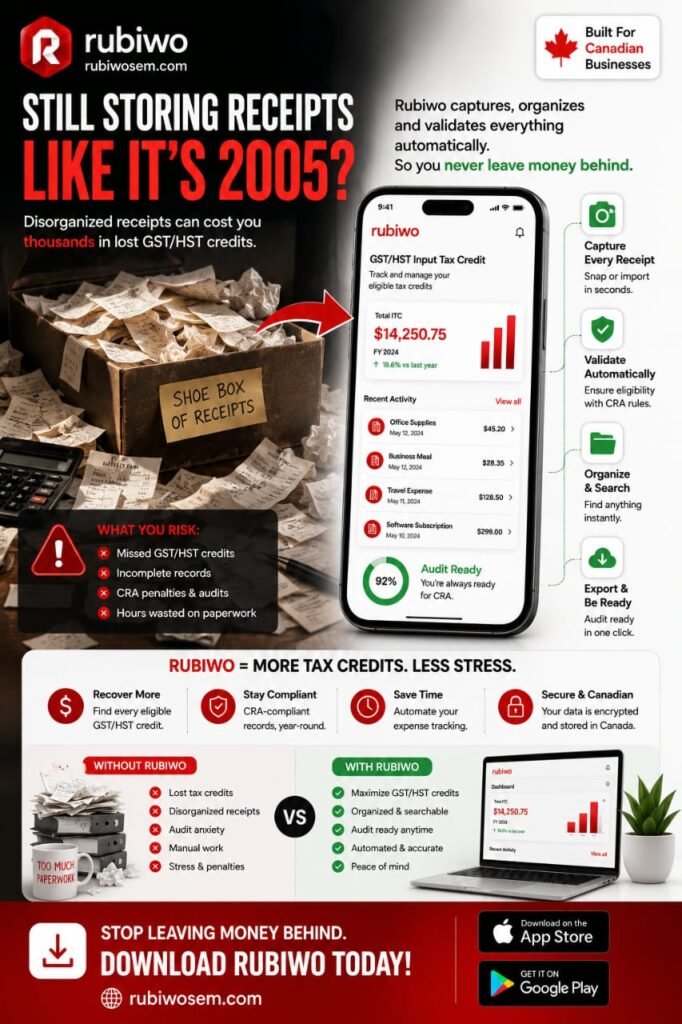
RubiWo gives you a Canadian-focused way to capture receipts, categorize business expenses, and preserve the details you need for tax preparation.
A useful workflow starts when you pay. Capture the receipt, identify the supplier and date, record the business purpose, and assign the expense category. For mixed costs, add the business-use percentage while the reason is still clear.
You can use the organized records to prepare T2125 categories, review credit card statements, reconcile a business bank account, and give your accountant cleaner source material. If you register for GST/HST, retaining tax details supports your review of input tax credits.
Spreadsheets can work when your volume is low and your process is disciplined. RubiWo provides a more structured record for freelancers who need receipts and expense details kept together, including purchases made through different payment methods. The app is available on iOS and Android at rubiwosem.com.
Turn Eligible Expenses Into Defensible Claims
A defensible deduction connects four pieces: the receipt, the business purpose, the calculation, and the tax treatment.
Keep the original receipt or a reliable digital copy, and add a short note explaining how the purchase helped earn business income. For shared costs, record the calculation behind the business-use percentage. For vehicles, maintain a mileage log. For meals, identify the attendees and reason for the meeting.
Review capital items separately, since CCA may apply. Review GST/HST separately when you claim input tax credits. These steps help you prepare a clearer tax return and respond efficiently if the CRA asks for support.
When an expense has mixed use, unusual facts, or a significant amount, ask a tax professional before filing. A record that explains the claim is more useful than a receipt that only proves payment.
Frequently Asked Questions
What tax deductions do freelancers miss in Canada most often? Canadian freelancers commonly miss eligible home office expenses, software subscriptions, bank fees, professional development, marketing costs, and business-use vehicle expenses. Each claim still requires a business purpose, reasonable allocation, and supporting records for the CRA.
What receipts should a freelancer keep for the CRA? Keep receipts that identify the supplier, date, purchase, amount, and applicable GST/HST, along with a note describing the business purpose. Digital copies are useful when they remain readable and can be retrieved for the required record-retention period.
Can freelancers claim home office expenses in Canada? Yes, when the workspace and work arrangement meet CRA requirements. Calculate the business-use portion of costs like rent, mortgage interest, utilities, home insurance, property taxes, and internet using a consistent, documented method.
How do freelancers claim vehicle expenses? You claim the business-use portion of eligible vehicle expenses and support it with a mileage log — recording business kilometres, total kilometres, trip dates, destinations, and business purposes, then keeping receipts for the related costs.
Are meals and entertainment deductible for freelancers? Eligible business meals and entertainment are subject to CRA restrictions and require a documented business purpose. Keep the receipt and record who attended, when the expense occurred, and how it related to earning business income.
Can GST/HST registrants claim input tax credits on business expenses? Yes, for eligible GST/HST paid on business purchases when CRA documentation requirements are met. Preserve invoices showing the relevant tax details and separate the input tax credit review from the income-tax deduction calculation.
What’s the practical next step for tracking missed deductions? Start capturing each receipt when you pay, then add the business purpose and business-use percentage before the details are forgotten. You can try RubiWo, a CRA-compliant expense tracking app for Canadian freelancers and small businesses, on iOS and Android at rubiwosem.com.